
The edge AI silicon market is open. We are building for it.
Defence, industrial automation, autonomous systems, and IoT at scale — markets LLMs cannot serve. Surface is the deterministic silicon solution.
Markets LLMs cannot serve
- Defence — cannot run air-gapped or guarantee deterministic output
- Industrial automation — too power-hungry and cloud-dependent for OT environments
- Autonomous systems — cannot fit vehicle compute envelopes or operate offline
- IoT at scale — 200B parameters on a sensor is impossible by design
SurfaceEDGE is the AI market expansion story.
If SurfaceCORE turns standard enterprise compute into AI infrastructure, SurfaceEDGE goes further: it pushes AI into the vast embedded, edge, industrial, sovereign and silicon markets that current LLM architectures cannot economically or physically access.
That is the real opportunity. Today's LLM stack was built for hyperscale GPU-cloud deployment. SurfaceEDGE is built for the opposite world: low-power devices, industrial controllers, autonomous systems, sovereign field deployments, vehicles, robotics, secure facilities and AI-on-Chip. In those environments, current AI is too heavy, too power-hungry, too memory-intensive and too cloud-dependent. SurfaceEDGE changes that.
The scale of that opportunity is enormous. The global edge AI market is already measured in the tens of billions of dollars and is forecast to grow rapidly through the decade. The embedded AI market is growing strongly. The AI hardware and embodied AI markets are expanding fast. And above all of that sits the global semiconductor market, measured in the hundreds of billions of dollars, into which SurfaceEDGE creates a new licensable category: not just AI software, but AI processor architecture, embedded runtime IP, OEM silicon libraries and future reference designs.
This is why SurfaceEDGE matters so much strategically. It is not trying to win inside the same arena as hyperscale LLMs. It opens the markets those systems are badly designed to serve: low-power intelligence, sovereign AI, industrial automation, embedded reasoning, defence-grade field systems, robotics and AI-on-Chip.
And SurfaceEDGE is not merely a cheaper endpoint. It is potentially the more native embodiment of the Surface architecture itself. Its dedicated DSP co-processing and custom AI processor design mean the silicon path is not a reduced version of the server path, but a route to higher-performance, lower-power execution in a form factor current AI stacks cannot match.
The investor thesis is simple: SurfaceEDGE does not compete for a share of the current LLM market. It expands the AI market into the embedded and silicon worlds that LLMs cannot reach — and in doing so creates future semiconductor, OEM and licensing value far beyond software alone.
AI beyond the limits of the LLM stack.
A new AI-on-Chip architecture for embedded, sovereign, and low-power intelligence.
Auroxeon is building SurfaceEDGE for markets that current LLM architectures cannot economically or physically reach: embedded systems, industrial controllers, vehicles, defence platforms, sovereign edge infrastructure, low-power autonomous systems, and Net Zero compute environments.
This matters because today's LLM stack is structurally locked out of these markets. It was built for hyperscale GPU-cloud deployment, high-memory inference, and internet-scale serving economics. That makes it powerful — and fundamentally unsuited to AI-on-Chip, embedded deployment, deterministic control environments, and silicon-native low-power intelligence. These markets represent the largest untapped AI silicon opportunity — billions of devices across industrial, defence, IoT, and autonomous systems.
SurfaceEDGE takes a very different approach.
It is powered by Auroxeon's unique tri-core AI processor and DSP co-processor, forming a quad-node AI compute architecture that accelerates execution beyond Surface's server-based performance.
Its foundational core is a 700MB mask ROM — a stable tensor oracle with infinite read endurance and total write isolation. Its learning core — which builds knowledge of its environment, workload, and successful solution strategies — sits in a 1GB non-volatile RAM. Bonded together in a 3D stack, SurfaceEDGE embodies a new class of low-power, high-performance AI computing in a custom semiconductor package.
That is deeply counterintuitive to conventional LLM thinking, and that is precisely why it matters.
In the LLM worldview, weights are treated as mutable software artefacts loaded into expensive memory hierarchies and served from power-hungry infrastructure. SurfaceEDGE breaks that assumption. The foundation weight is static, physical, mask-committed silicon — a stable tensor oracle with infinite read endurance and total write isolation — while adaptation happens in the dynamic cognitive substrate.
SurfaceEDGE is also not simply a silicon port of the server architecture. Its embedded design introduces dedicated DSP co-processing, giving the silicon implementation a more native and more efficient execution path than server-based deployments on general-purpose compute.
Static. Physical.
Cannot be changed.
Builds in field.
No retraining.
From 60% raw.
Every chip works.
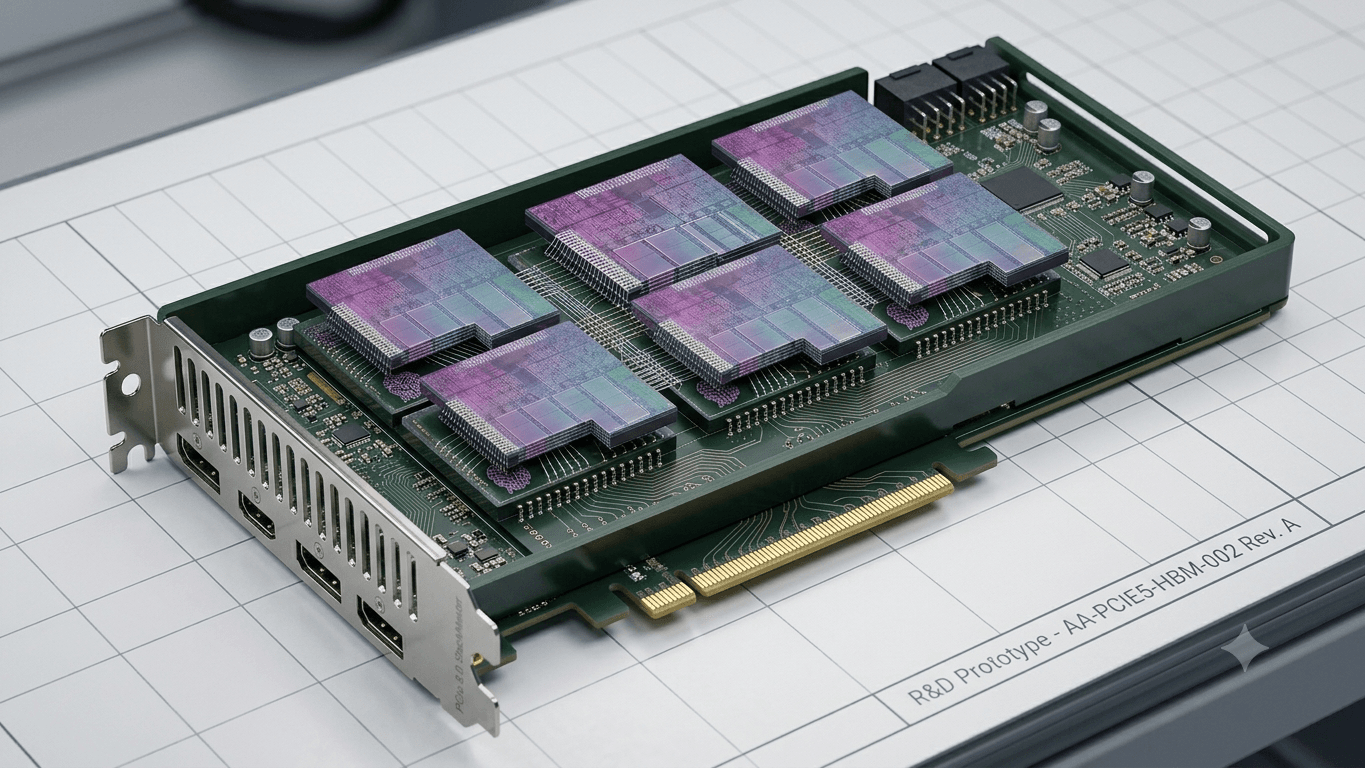
Surface EDGE Processor — PCIe 5.0 form factor, R&D prototype board
The AI-on-Chip path is not a reduced-capability version of Surface. It is potentially a higher-performance embodiment of the architecture.
Silicon specification — qualified enquiries only.
14 patents. Filed May 2025.
Every layer of the Surface architecture is covered — model, attention, execution, reasoning, memory, knowledge, learning, clustering, and silicon embodiment.
The silicon filing covers the Geode hardware embodiment directly. A device built around Geode architecture cannot be produced without licence.
Programme
- Use of funds: Phase 1–2 Geode development, US commercial development, strategic partnership programme
- Roadmap: Phase 1 MCU prototype H1 2026, Phase 2 Full Geode Q1 2027, PoC February 2027
- UK validation: SIRC, Innovate UK Phase 1 PoC, 14 patents filed, RT180-A performance profile established
Request an investor conversation
Silicon architecture documentation, 3D IC specification, and IP portfolio overview available to qualified investors.